If you have ever tried to list consulting work inside an ecommerce platform, you have hit a strange wall. Product taxonomies were built for physical goods, and a digital marketing consultant does not fit neatly into shelves, sizes or SKUs. Yet the classification question matters more than it first appears.
Getting the category wrong affects how your listing is indexed, which filters surface it, how payment processors assess risk, and in some cases how your revenue is reported for tax purposes.
This article explains where a digital marketing consultant actually belongs in ecommerce taxonomy, why different systems disagree, and how to classify service offerings without creating downstream problems.
What Is Ecommerce Taxonomy?
Ecommerce taxonomy is the structured classification system that organises everything sold on a platform into hierarchical categories. Google's product taxonomy, Amazon's browse nodes, Shopify's standard product taxonomy and the UNSPSC standard are all examples, and none of them agree perfectly with one another.
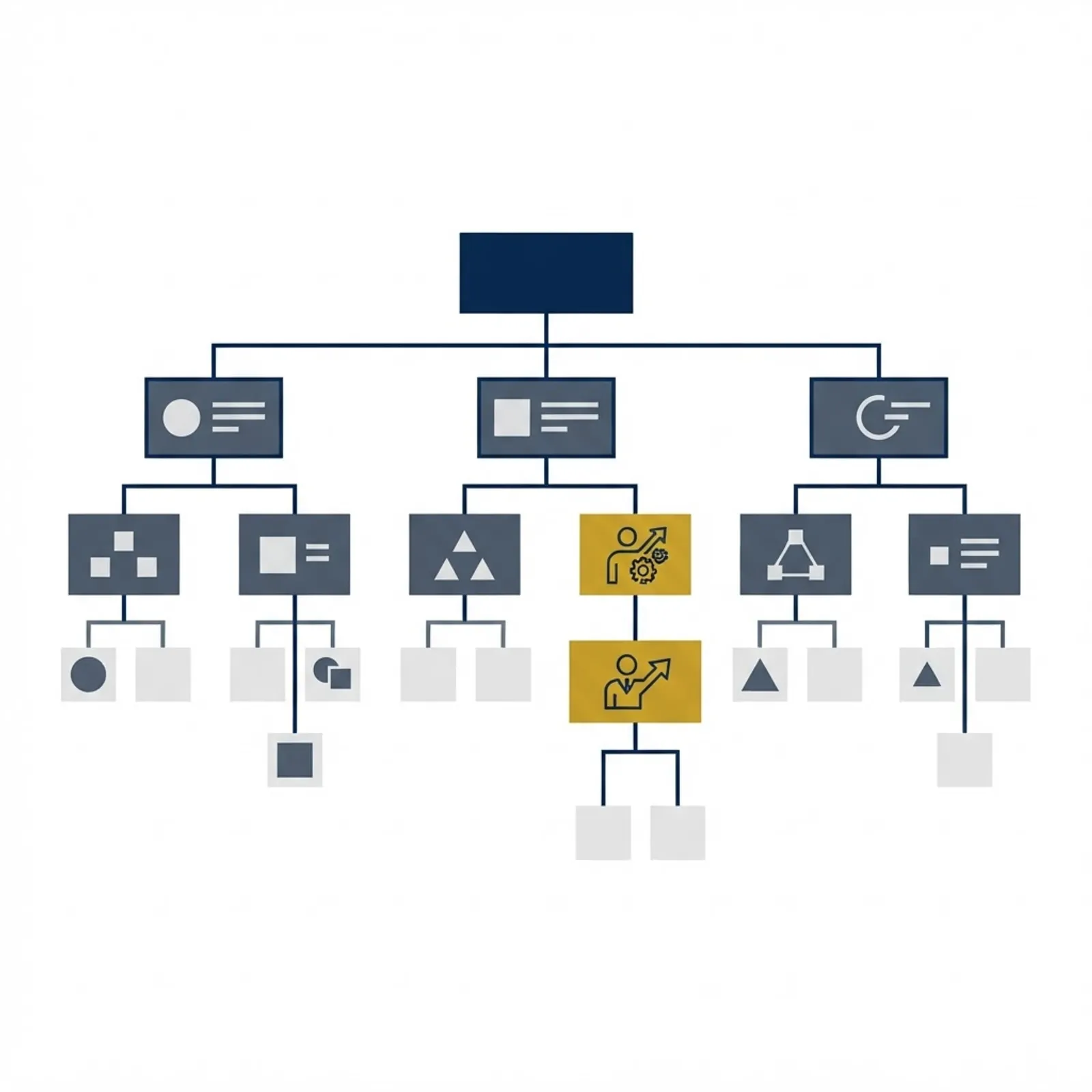
Each system works as a tree. A broad top-level category narrows into increasingly specific branches until it reaches a leaf node that describes a single type of item. The deeper and more accurate your leaf node, the better your discoverability and reporting.
Services sit awkwardly in these trees because taxonomies evolved for tangible inventory. Most major systems bolted on service branches later, which is why the placement feels inconsistent across platforms.
Who Needs to Get This Right?
Classification is not an academic exercise. Several groups depend on accurate placement.
- Consultants and agencies selling packaged services through online storefronts
- Marketplace operators building service categories for their sellers
- Developers configuring product feeds for Google Merchant Center or comparison engines
- Finance teams mapping revenue to accounting and tax categories
- Procurement departments matching supplier codes to internal purchasing systems
Key Classification Frameworks
Google Product Taxonomy
Google's taxonomy is product-centric and historically resistant to pure services. Digital marketing consulting generally does not have a native leaf node, so most sellers map to a business and industrial services branch or exclude the item from product feeds entirely and promote it through standard search instead.
UNSPSC Codes
The United Nations Standard Products and Services Code handles this far better. Digital marketing consulting typically falls under segment 80000000, Management and Business Professionals and Administrative Services, within the advertising and marketing management family. This is the classification procurement teams most often expect.
NAICS and Industry Codes
In North America, a digital marketing consultant usually maps to NAICS 541613, Marketing Consulting Services, or 541810 for advertising agencies. This matters for business registration, insurance and tax reporting rather than ecommerce display.
Platform-Specific Service Categories
Shopify, WooCommerce and similar platforms let you define a service as a product type with no shipping requirement. Here the practical answer is a custom category such as Services > Marketing > Digital Marketing Consulting, mapped to a standard code in the background.
How to Classify a Consulting Offer
The right approach is to classify once, deliberately, and then propagate that decision everywhere.
- Decide whether you are selling a defined deliverable or open-ended advisory time — they classify differently
- Identify the primary taxonomy your platform requires, such as Google, Shopify standard or UNSPSC
- Find the closest existing leaf node rather than inventing a new top-level category
- Map that node to a UNSPSC code for procurement compatibility
- Record the equivalent NAICS code for accounting and tax use
- Document the mapping so future listings stay consistent
- Review annually, since taxonomies are revised and service branches expand
Benefits of Correct Placement
Accurate taxonomy is quietly one of the highest-leverage technical details in a service storefront.
- Better organic and on-platform discoverability through category filters
- Cleaner analytics, because revenue groups sensibly rather than landing in a miscellaneous bucket
- Smoother procurement approval when enterprise clients require standard codes
- Reduced risk of listing rejection or payment processor misclassification
- Easier expansion later, since a well-structured tree accommodates new offerings
Potential Challenges
Several complications arise consistently when classifying consulting services.
- No single global standard exists, so cross-platform mapping is always manual
- Hybrid offerings — consulting plus software plus implementation — span multiple branches
- Taxonomies update periodically and break existing mappings without warning
- Over-specific custom categories fragment your catalogue and dilute filter value
Best Practices
A few principles keep service classification maintainable as you grow.
- Use the broadest accurate category rather than the most flattering one
- Maintain a single source of truth mapping table in your product information system
- When a hybrid offer spans categories, classify by the dominant revenue component
- Avoid creating custom top-level categories unless you operate the marketplace yourself
Real-World Example
A boutique consultancy packaged a fixed-scope SEO audit and sold it through their own store. Initially they listed it under a vague Other category, and it never appeared in any on-site filter. Enterprise buyers also stalled at procurement because no standard code was supplied.
They reclassified the audit under a Services > Marketing > Analytics and Strategy path, attached the corresponding UNSPSC code to the product metadata, and surfaced it through a redesigned catalogue built with proper ecommerce solutions for service-based selling. Procurement friction dropped immediately and the listing began appearing in relevant filtered searches.
Why It Matters
Taxonomy is infrastructure. Nobody praises it when it works, but everything from search visibility to invoice approval depends on it. For consultants moving from invoicing to productised online sales, classification is the difference between a catalogue that scales and one that becomes unmanageable at forty listings.
It also signals professionalism. A cleanly categorised service catalogue tells buyers you have thought about how they purchase, not only about what you deliver.
Frequently Asked Questions
Is a digital marketing consultant a product or a service in ecommerce?
Technically a service, but most platforms sell it using a product record with shipping disabled. The underlying classification should still use a service taxonomy branch rather than a physical goods node.
What UNSPSC code fits digital marketing consulting?
Codes within the 80141600 advertising and 80101500 business consulting families are the usual fit, depending on whether the engagement emphasises campaign management or strategic advisory work.
Can I list consulting services in Google Merchant Center?
Google Shopping is designed for physical products and most pure consulting listings are disallowed. Promote consulting through standard search campaigns and organic content instead of product feeds.
Should each service package have its own category?
No. Create categories that buyers would naturally browse, and use attributes or tags to differentiate packages within them. Excessive categories make navigation worse, not better.
Conclusion
A digital marketing consultant belongs in the professional and business services branch of ecommerce taxonomy, mapped to UNSPSC advertising or consulting families and represented on-platform as a non-shippable service product. Decide the mapping once, document it, and apply it everywhere.
If your service catalogue has outgrown its structure, a thoughtfully architected storefront fixes both classification and conversion at the same time. Explore how back-end development for structured product catalogues can support it.